
- Registered healthcare provider, RPWDL register no. 000000229528
- Almost 700 locations within BadamySie.pl: blood collection, diagnostic tests and specialist consultations
- We carry out tests and consultations ourselves and through subcontractors
- Results online, no referral needed
- Operating since 2020 as the continuation of Poland’s first online shop for medical tests (sklep.etermed.pl, since 2013)
53,00 zł
Blood draw included in the price. How does it work?This price applies when you buy and pay online at BadamySie.pl; prices on site may differ. Please bring an ID document to your test.
- No referral needed
- Results online
- Almost 700 locations
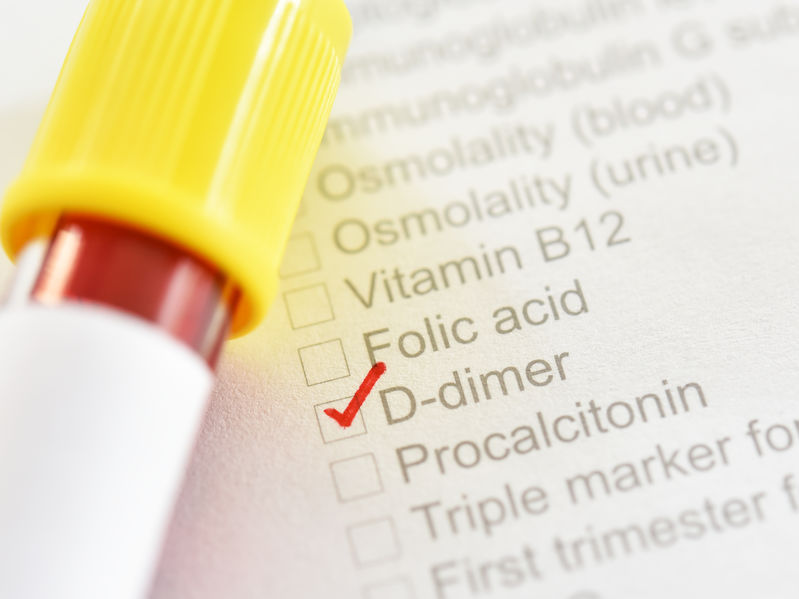
A test used in the diagnosis of thromboembolic disease.
Description
Why D-dimer is tested
D-dimers are fragments of fibrin produced when the body breaks down a clot. Their presence in the blood means that a clot is actively forming and breaking down somewhere in the blood vessels. The test is most useful for ruling out disease: a normal result in someone with a low or moderate clinical probability virtually rules out deep vein thrombosis and pulmonary embolism (risk of an event within 3 months below 1%). An elevated result does not establish a diagnosis, as levels rise in many other situations.
When to have this test
- swelling, pain, redness and warmth in one calf or thigh (suspected deep vein thrombosis),
- sudden breathlessness, chest pain, a rapid heart rate or fainting (suspected pulmonary embolism: this is an emergency; call for help and do not wait for results from a blood collection point),
- after prolonged immobility, a flight, surgery or injury, or when using hormonal contraception with risk factors,
- assessment of the risk of recurrence after completing anticoagulant treatment,
- suspected disseminated intravascular coagulation (DIC), follow-up after COVID-19 as advised by your doctor.
How to prepare
- Fast for 8–12 hours and drink only water in the morning. Have your blood sample taken in the morning.
- Avoid strenuous exercise and alcohol the day before; do not smoke on the morning of the test.
- Tell your doctor about any anticoagulants (which lower the result), hormones, recent surgery, injury or infection.
- If symptoms suggest pulmonary embolism, the test is performed in hospital, not as a routine scheduled test.
Understanding your result
Results are reported in µg/l FEU (fibrinogen equivalent units) or ng/ml FEU; some methods use DDU units, which have different thresholds, so compare your result with the reference range on the report.
| Result | What it usually means |
|---|---|
| below 500 µg/l FEU | with a low or moderate clinical probability, thrombosis and pulmonary embolism are unlikely |
| below age × 10 µg/l (over 50 years of age) | age-adjusted threshold according to ESC 2019; at age 70, 700 µg/l; increases the proportion of people in whom pulmonary embolism can be ruled out without increasing false-negative results |
| above the threshold | requires further diagnostic imaging; other causes include infection, inflammation, pregnancy, cancer, injury, surgery, heart attack, stroke, liver and kidney disease, and age |
In people with a high clinical probability of thrombosis, D-dimer is not measured; imaging is performed straight away instead. The specificity of the test decreases with age (to around 10% in people over 80).
What to test alongside D-dimer
Doctors often also request a full blood count (platelets), APTT, PT (INR), fibrinogen and CRP; after thrombosis with no obvious cause, tests for thrombophilia may be requested. More about thrombosis: Badania-Medyczne.pl.
Frequently asked questions
My D-dimer is elevated. Does this mean I have thrombosis?
Not necessarily. D-dimer levels rise with infection, after surgery and injury, during pregnancy, with cancer and after the age of 50. A high result does not diagnose thrombosis but calls for further investigations (venous ultrasound (USG), CT angiography (angio-TK)). A normal result with a low clinical probability allows thrombosis to be ruled out.
What is the normal D-dimer level after the age of 50?
The standard threshold is 500 µg/l FEU. ESC guidelines allow an age-adjusted threshold: age × 10 µg/l in people over 50, e.g. 700 µg/l at age 70.
Is D-dimer reliable during pregnancy?
Levels rise naturally, especially in the II and III trimesters and after childbirth, so they are more often “elevated” without thrombosis. The result is interpreted by the doctor overseeing your pregnancy.
Sources: ALAB laboratoria, D-dimer (preparation, 500 µg/l FEU threshold, causes of elevated levels, pregnancy); Konstantinides S.V. et al., 2019 ESC Guidelines for the diagnosis and management of acute pulmonary embolism, European Heart Journal 2020 (value in ruling out disease, age × 10 µg/l threshold, specificity in older people). This information does not replace a medical consultation.
Customer reviews
How we verify reviews
Reviews of tests can only be added by people who bought the test at BadamySie.pl. A review can only be added via the link in the e-mail sent after the order is completed, so every review is linked to an order. Our team checks text comments before they are published. We also publish negative reviews, without changing their content; we only reject spam, offensive language and personal data. The stars above the test description (“Rating: … · … ratings”) are votes from website visitors and are not verified. The reviews on the “Customer reviews” page are recommendations from our Facebook profile.
You can add a review using the link in the e-mail we send after your order is completed.
Where you can have this test
You choose the collection point when you order. Addresses, opening hours and preparation tips are in our city guide:
- Warsaw (75)
- Wrocław (35)
- Łódź (30)
- Krakow (29)
- Poznań (27)
- Gdańsk (22)
- Szczecin (22)
- Bydgoszcz (13)
- Gdynia (13)
- Rzeszów (13)
- Kielce (11)
- Lublin (11)
- All cities (57)
How to prepare for a blood test (fasting, medication, exercise), in Polish
Frequently bought together
 Full blood count with automated differential - laboratory test20,99 złAdd to basket
 Alanine aminotransferase (ALT) - laboratory test26,40 złBlood draw included in the priceAdd to basket
 C-reactive protein (CRP)24,60 złBlood draw included in the priceAdd to basket
 Aspartate aminotransferase (AST) - laboratory test16,20 złBlood draw included in the priceAdd to basket
 Fibrinogen - laboratory test21,40 złBlood draw included in the priceAdd to basket
 Glucose - laboratory test15,30 złBlood draw included in the priceAdd to basket
 Lipid profile (cholesterol) - laboratory test47,99 złAdd to basket
 APTT - laboratory test19,80 złBlood draw included in the priceAdd to basket


Reviews
There are no reviews yet.