
- Podmiot leczniczy, nr księgi RPWDL 000000229528
- 700 punktów pobrań krwi, badań diagnostycznych i konsultacji specjalistycznych
- Badania i konsultacje realizujemy samodzielnie oraz przez podwykonawców
- Wynik online, bez skierowania
- Działamy od 2020 r., kontynuacja pierwszego w Polsce internetowego sklepu z badaniami (sklep.etermed.pl, od 2013)
Original price was: 49,00 zł.42,60 złCurrent price is: 42,60 zł. Oszczędzasz 13%!
Najniższa cena z 30 dni przed obniżką: 49,00 zł
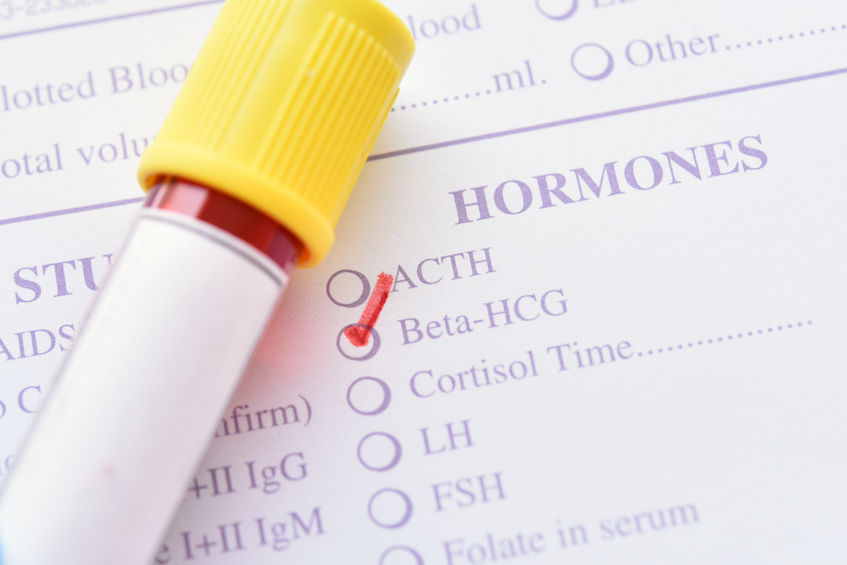
Beta hCG (human chorionic gonadotrophin) testing is used to confirm and monitor pregnancy.
Drodzy Pacjenci! W związku z częstymi pytaniami informujemy, iż prezentowane w portalu ceny obowiązują jedynie przy dokonaniu płatności przelewem. Poszczególne placówki mogą mieć te same usługi w innych cenach! Prosimy także o każdorazowe okazywanie aktualnego dokumentu tożsamości podczas realizacji wykupionych usług.
Opis produktu
Why beta hCG is tested
Human chorionic gonadotrophin (hCG) is a hormone produced by the embryo and placenta from implantation onwards. A quantitative blood test detects pregnancy earlier and more reliably than a urine test, and the numerical result allows its progression to be monitored: in early pregnancy, the concentration doubles every 2–3 days, peaks around weeks 8–10, then falls and stabilises. Outside pregnancy, hCG can be a marker of certain tumours (hydatidiform mole, germ cell tumours, including in men).
When to consider this test
- suspected pregnancy, especially when a urine test is negative or inconclusive and your period is late,
- after embryo transfer during IVF (usually around 10 days after transfer),
- abdominal pain or spotting in early pregnancy (suspected ectopic pregnancy or miscarriage), always alongside ultrasound,
- before an X-ray, CT scan, procedure or starting medicines contraindicated in pregnancy,
- monitoring after miscarriage or a molar pregnancy (the concentration should fall to zero),
- cancer investigations at a doctor’s request.
How to prepare
- Fasting is not required, and the sample can be collected at any time of day. For repeat testing, use the same time of day to compare results.
- Tell your doctor about medicines containing hCG (used to stimulate ovulation, e.g. Pregnyl, Ovitrelle): they raise the result for several days.
- To compare changes over time, have both tests performed at the same laboratory; different methods produce different values.
Understanding your result
Results are reported in mIU/ml (equivalent to IU/l). Reference ranges by week of pregnancy are very broad and vary between laboratories, so the doctor primarily assesses changes over time rather than a single value.
| Result | What it usually means |
|---|---|
| below 5 mIU/ml | negative result; if tested very early, repeat after 2–3 days |
| 5–25 mIU/ml | inconclusive range: very early pregnancy, biochemical pregnancy loss or residual hCG from medicines; repeat after 48 h |
| above 25 mIU/ml, doubling within 48–72 h | a normally progressing early pregnancy |
| rising more slowly than doubling, or falling | risk of ectopic pregnancy or miscarriage; urgent consultation and ultrasound |
| 1000–2000 mIU/ml without a gestational sac in the uterus on ultrasound | suspected ectopic pregnancy |
| much higher than expected | multiple pregnancy, incorrectly calculated gestational age or, rarely, a hydatidiform mole |
After menopause, the pituitary gland secretes trace amounts of hCG (usually up to approximately 14 mIU/ml), which do not indicate pregnancy. High hCG in a man or a woman who is not pregnant requires investigation for cancer.
Other tests to consider alongside beta hCG
In early pregnancy, the doctor often also requests progesterone, and at the start of pregnancy, full blood count, TSH, glucose, blood group, toxoplasmosis testing and rubella testing. Conveniently combined in a panel: pregnancy test panel. Read more: Badania-Medyczne.pl.
Frequently asked questions
How soon after intercourse can a beta hCG blood test detect pregnancy?
The hormone appears in the blood after embryo implantation, 6–12 days after fertilisation. A blood test can detect pregnancy around a week after fertilisation, usually several days before the expected period and earlier than a urine test.
What does a result below 5 mIU/ml mean?
A negative result: no pregnancy. If testing was performed very early, the doctor may recommend repeating it after 2–3 days. In women after menopause, low concentrations (up to the low teens in mIU/ml) can be normal and do not indicate pregnancy.
Why does the doctor ask me to repeat the test after 48 hours?
Because in a normal early pregnancy, the concentration doubles every 2–3 days. A rise that is too slow or a fall suggests ectopic pregnancy or miscarriage, which a single result will not reveal.
Sources: ALAB laboratoria, Beta HCG (doubling every 48 h, peak at weeks 8–10, ectopic pregnancy, IVF); Mayo Clinic Laboratories, hCG Quantitative, Pregnancy, Serum (threshold <5 IU/L, doubling every 2–3 days, 1000–2000 IU/L and a gestational sac on ultrasound, hCG after menopause). For information only; does not replace medical advice.
Opinie klientów
Gdzie wykonasz to badanie
Punkt pobrań wybierasz przy zamówieniu. Adresy, godziny i zasady przygotowania znajdziesz w naszym przewodniku po miastach:
- Warszawa (76)
- Wrocław (35)
- Łódź (31)
- Kraków (30)
- Poznań (28)
- Gdańsk (22)
- Szczecin (22)
- Bydgoszcz (13)
- Gdynia (13)
- Rzeszów (13)
- Kielce (11)
- Lublin (11)
- Wszystkie miasta (20)
Jak przygotować się do badania krwi (na czczo, leki, trening)
Related products
-
Sale!
Free triiodothyronine (FT3) – laboratory test
Original price was: 45,00 zł.38,20 złCurrent price is: 38,20 zł. Add to cart -
Sale!

25-hydroxyvitamin D (25 OH) – vitamin D test
Original price was: 99,00 zł.85,00 złCurrent price is: 85,00 zł. Add to cart -
Sale!

Sodium (Na) – laboratory test
Original price was: 16,00 zł.14,40 złCurrent price is: 14,40 zł. Add to cart -
Sale!
Aspartate aminotransferase (AST) – laboratory test
Original price was: 18,00 zł.16,20 złCurrent price is: 16,20 zł. Add to cart
Reviews
There are no reviews yet.