

- Registered healthcare provider, RPWDL register no. 000000229528
- Almost 700 locations within BadamySie.pl: blood collection, diagnostic tests and specialist consultations
- We carry out tests and consultations ourselves and through subcontractors
- Results online, no referral needed
- Operating since 2020 as the continuation of Poland’s first online shop for medical tests (sklep.etermed.pl, since 2013)
79,00 zł
This price applies when you buy and pay online at BadamySie.pl; prices on site may differ. Please bring an ID document to your test.
- No referral needed
- Results online
- Almost 700 locations
A microbiological test to identify infection with fungi of the genus Candida, which are classified as yeasts.
Description
Why test for yeast-like fungi in stool
This is a stool culture for yeast-like fungi, mainly of the genus Candida. The laboratory cultures the sample on a fungal growth medium and reports the result semi-quantitatively, meaning it describes whether yeasts have grown and in approximately what quantity. If they do grow, it usually also identifies the species, for example Candida albicans. It is important to know that Candida is part of the natural flora of the digestive tract: in a study of 695 healthy adults, C. albicans yeasts were detected in the intestines of around 83% of participants. The result is therefore only meaningful when considered alongside symptoms and risk factors.
When to consider this test
- chronic diarrhoea, bloating or abdominal pain after prolonged antibiotic treatment,
- persistent itching and redness around the anus,
- poorly controlled diabetes or long-term steroid treatment with bowel symptoms,
- a weakened immune system (e.g. during cancer treatment or following a transplant) and bowel symptoms,
- follow-up after antifungal treatment, if recommended by your doctor.
How to prepare
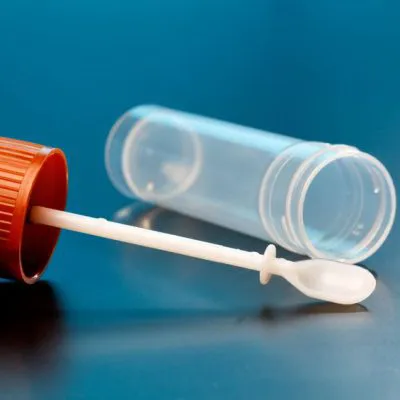
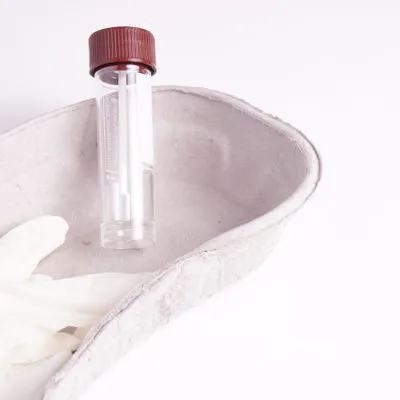
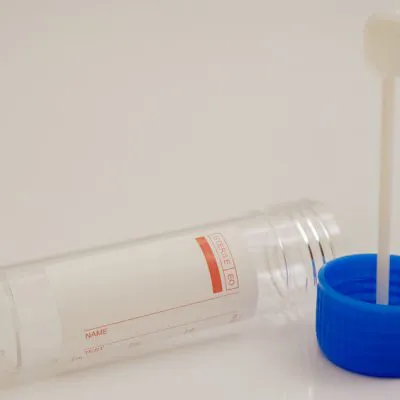
The test does not require a special diet or fasting. Pass stool into a clean, dry receptacle or onto a collection pad, ensuring that the sample does not come into contact with toilet water, urine or cleaning products. Use the scoop provided with the container to collect several small portions from different parts of the stool, close the container tightly, label it and deliver it to the collection point as soon as possible. If you take antifungal medicines, antibiotics or probiotics, ask your doctor when to have the test, as these may affect the result.
How to interpret the result
| Result | What it usually means |
|---|---|
| No growth of yeast-like fungi | no yeasts were grown from the stool sample |
| Scanty or light growth | common in healthy people; without symptoms, this usually indicates natural colonisation, not disease |
| Moderate or heavy growth | possible yeast overgrowth, e.g. after antibiotics, with diabetes or a weakened immune system; requires assessment by a doctor alongside symptoms |
| Species reported (e.g. Candida albicans, C. glabrata) | information that helps the doctor select treatment, if needed |
The presence of Candida in stool alone does not establish a diagnosis of candidiasis, and a negative result does not rule out infection elsewhere in the digestive tract, for example in the mouth or oesophagus. The scale used to describe the amount of growth varies between laboratories, so refer to the description on your report.
Other tests to consider
If you have bowel symptoms, consider: faecal calprotectin, general stool examination, stool culture, glycated haemoglobin HbA1c (if diabetes is suspected). Read more: Badania-Medyczne.pl.
Frequently asked questions
Does Candida in stool mean an intestinal fungal infection?
No. Candida yeasts are part of the natural flora of the digestive tract and are detected in most healthy people. A doctor diagnoses candidiasis based on symptoms, risk factors and other tests, not on a stool culture alone.
How much stool should I collect for the test?
Several small portions of stool collected with the scoop from different areas are enough, following the instructions on the container. Keeping the sample clean is more important than the quantity: it must be free from toilet water, urine and cleaning products.
Why does it take up to 15 working days to get the result?
This is a culture test: yeasts must grow on a culture medium, and the colonies that grow are then identified. Fungi grow more slowly than most bacteria, so the result is not available after one day.
Sources: ALAB laboratoria, Culture for yeast-like fungi (turnaround time, preparation); ALAB laboratoria, Fungal infection (candidiasis) of the intestines and digestive tract (Candida as commensal flora, risk factors, symptoms); Delavy et al., Gut Microbes 2023, Pasteur Institute, C. albicans carriage in 695 healthy people (82,9%); Szpital Uniwersytecki w Krakowie, Mycological tests (stool fungal culture, identification). This information does not replace a medical consultation.
Customer reviews
How we verify reviews
Reviews of tests can only be added by people who bought the test at BadamySie.pl. A review can only be added via the link in the e-mail sent after the order is completed, so every review is linked to an order. Our team checks text comments before they are published. We also publish negative reviews, without changing their content; we only reject spam, offensive language and personal data. The stars above the test description (“Rating: … · … ratings”) are votes from website visitors and are not verified. The reviews on the “Customer reviews” page are recommendations from our Facebook profile.
Show only reviews in English (0)
You can add a review using the link in the e-mail we send after your order is completed.
Where you can have this test
You choose the collection point when you order. Addresses, opening hours and preparation tips are in our city guide:
- Warsaw (75)
- Wrocław (35)
- Łódź (30)
- Krakow (29)
- Poznań (27)
- Gdańsk (22)
- Szczecin (22)
- Bydgoszcz (13)
- Gdynia (13)
- Rzeszów (13)
- Kielce (11)
- Lublin (11)
- All cities (57)
How to prepare for a blood test (fasting, medication, exercise), in Polish
Frequently bought together

Related products
-

Oestrogen test package
209,00 złBlood draw included in the price Add to cart -

Basic athlete test package
67,00 złBlood draw included in the price Add to cart -
Prostate test package
104,00 złBlood draw included in the price Add to cart -

Male infertility test package
191,00 złBlood draw included in the price Add to cart
Reviews
There are no reviews yet.